
Whether you manage a factory, warehouse, security operation, hotel, or construction project, reliable push-to-talk communication matters. One of the first decisions is whether to continue using analog FM radios or invest in Digital Mobile Radio (DMR). Neither technology is automatically the right choice for every facility.
This guide explains the underlying differences, what they mean in day-to-day operations, and how to choose equipment without confusing marketing claims with practical engineering. It also shows how Wireless Signal can support equipment selection, programming, RF coverage studies, installation, and ongoing service in Saudi Arabia.
Professional digital radio
1. How do analog two-way radios work?
Traditional analog radios typically use frequency modulation (FM) to carry voice. Pressing the Push-to-Talk (PTT) button transmits the speaker's voice over a configured radio channel to other compatible radios. Communication can be direct between handsets or use a repeater when additional coverage is necessary and the system is designed for it.
Analog radio remains useful because it is familiar, straightforward, and can be economical for smaller operations. Organizations with working analog equipment may also avoid immediate replacement costs. However, as the received signal weakens, users commonly hear more hiss, noise, or distortion; voice quality tends to decline gradually near the coverage boundary.
In a typical conventional analog system, a channel supports one conversation at a time. Additional simultaneous talk groups may require more channel resources, careful frequency planning, and sometimes extra infrastructure.
2. What exactly is DMR?
Digital Mobile Radio (DMR) is a family of digital radio standards developed by the European Telecommunications Standards Institute (ETSI). Instead of sending a continuously varying analog voice signal, a DMR radio encodes speech digitally for transmission over the radio interface. Depending on the equipment, operating tier, and configuration, DMR systems can support radio identity, group calls, individual calls, and selected data-related functions.
Professional DMR Tier II uses Time Division Multiple Access (TDMA). A 12.5 kHz channel is divided into two time slots, enabling two logical communication paths under suitable system conditions—for example, through a compatible DMR repeater. This is an important efficiency benefit, but it does not mean every radio always delivers two simultaneous conversations, particularly in direct mode. Implementation and infrastructure matter.
Engineering note: the two TDMA slots share one 12.5 kHz radio channel; they are not two separate 12.5 kHz frequencies. DMR's channel efficiency is one reason professional systems often consider it for growing operations.
3. DMR vs analog: side-by-side comparison
| Decision factor | Analog FM | Digital DMR |
|---|---|---|
| Voice transmission | Analog modulated voice | Digitally encoded voice over RF |
| Weak-signal behavior | Noise often increases progressively | Speech may stay consistent, then drop rapidly near the decoding limit |
| Channel capacity | Typically one conversation per conventional channel | Two TDMA time slots in one 12.5 kHz channel with compatible systems |
| Battery endurance | Depends on equipment and duty cycle | May improve with TDMA; not guaranteed across models |
| Operational functions | Basic voice and model-dependent features | Identity, group management, selective calls and data features depending on model |
| Budget | Often lower entry cost for a simple existing system | May involve more equipment, programming and infrastructure investment |
| Migration | Can preserve existing equipment | Requires compatibility checks and a planned transition |
Actual performance is equipment-specific. Frequency, antennas, repeaters, programming, environment, and operating conditions can materially affect the result.
4. Does digital always sound better?
In an area with adequate radio signal, digital voice processing can deliver consistent intelligibility and can support advanced noise-reduction features in properly equipped models. This may help teams working in factories, loading areas, construction sites, and other noisy spaces. Yet it is inaccurate to promise that every digital radio sounds better in every location.
At the edge of RF coverage, digital speech may become broken or unintelligible once errors exceed what the system can correct. Analog FM frequently deteriorates more gradually, with increasing audible noise. Microphone quality, loudspeaker design, protective equipment, ambient noise, and the way a device is worn can all influence real-world communication quality.
5. Will DMR radios give you longer range?
Not automatically. Radio range is governed by propagation and system engineering: operating frequency, authorized transmit power, receiver sensitivity, antenna type and height, terrain, steel structures, interference, and whether suitable repeaters are installed. Digital technology may improve voice intelligibility over part of a coverage area, but it does not eliminate physical obstructions or guarantee more distance.
For a warehouse full of metal racking, an industrial site with multiple buildings, or a wide construction project, an RF site survey is often more useful than guessing from a product's advertised range. Changes to antenna placement, system layout, or repeater locations can have more impact than simply changing the type of handset.
6. Why do time slots and talk groups matter?
A team with a handful of occasional users may be well served by a basic analog setup. Larger operations may need separate security, maintenance, production, or logistics talk groups and more predictable access to communications. Properly designed DMR networks can improve the use of channel resources and provide flexible ways to organize users.
Features such as radio IDs, private calls, dispatch integration, messaging, remote management, or emergency functions are product- and configuration-dependent. A buyer should confirm which capabilities are supported by the exact radio model, software, and infrastructure rather than assuming they are standard in every DMR device.
7. Is battery life better with DMR?
TDMA operation can reduce transmitter duty time under certain conditions and may support longer battery endurance. However, a radio's real operating time also depends on transmit power, battery capacity and age, screen use, GPS, Bluetooth, volume, and the ratio of transmitting, receiving and standby. Always compare manufacturer test conditions and, where possible, field-test radios across a representative work shift.
For a concrete example, the official BelFone BP660 brochure states an average operating time of 22 hours in digital mode versus 16 hours in analog mode under the manufacturer's 5/5/90 duty cycle. These are model-specific test figures, not a universal promise for all DMR radios or every use case.
8. Can DMR radios communicate with existing analog radios?
Many professional DMR handsets support both digital and analog operating modes, helping organizations plan a gradual upgrade. But supporting both modes does not mean a conventional analog radio can directly decode a digital DMR transmission. The operating mode, frequencies, channel settings, signaling, and compatibility must match. Some mixed-system arrangements require a dedicated gateway or other integration equipment.
For organizations migrating away from analog equipment, a reliable plan includes an inventory of existing radios, business-critical coverage and call groups, technical tests during the transition, consistent programming, and user training. Migrating in stages can help avoid operational disruption when properly engineered.
9. Which system should your organization choose?
Analog may be practical if:
- You operate a small team with straightforward voice requirements.
- Existing analog radios remain serviceable and replacement would add little operational benefit.
- You do not need advanced user management, capacity, or data functions.
DMR may be worth considering if:
- You need multiple teams and a more structured talk-group design.
- Digital operating features and better channel utilization could support expansion.
- You plan repeaters, site coverage improvements, or professional system integration.
- You want a managed, phased migration from your current analog fleet.
Selection checklist: define the number of users, site size, buildings and obstructions, daily duty cycle, talk groups, security expectations, reliability targets, and applicable frequency licensing requirements before selecting a device model.
10. A real product example: BelFone professional DMR
The BelFone BP-660 is one example worth evaluating for professional digital radio deployments. According to BelFone's published specifications, it supports DMR, carries an IP68 protection rating, and lists capacity for 1,024 channels. Actual frequency variants and operating features must be checked against the ordered model, configuration, and Saudi regulatory requirements. The BP-860 is another product that may be considered depending on project needs.
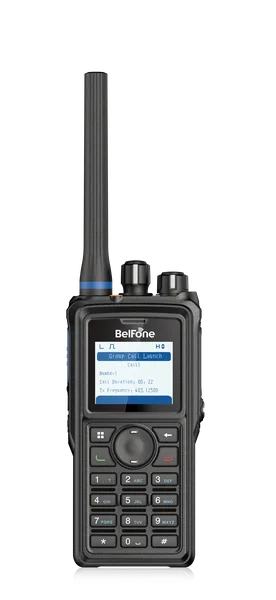
BelFone BP-660
An example of a professional DMR handset for field operations, subject to requirements for coverage, compatibility, configuration, and approved use.
Wireless Signal can help assess the complete communication solution, including device selection, frequency and network planning, programming, supply, installation, coverage assessment, and technical support according to the project scope. Buying radios is only one element of a reliable operational communication system.
11. What should buyers check in Saudi Arabia?
Use of radio equipment and spectrum in Saudi Arabia is subject to applicable requirements from the Communications, Space & Technology Commission (CST). Some professional radio applications require frequency licensing or other approvals depending on the radio service, spectrum, equipment type, and intended operation. Worldwide product availability does not automatically establish authorization to operate on any desired frequency inside the Kingdom.
Before purchasing and commissioning a system, verify the relevant regulations and licensing route. The official CST Radio Frequency Licenses service is one useful starting point for that review.
Frequently asked questions
Can DMR radios work without mobile coverage or internet?
Yes. Compatible DMR systems can communicate directly between radios or over a dedicated repeater without relying on a public mobile network. Coverage depends on the RF design and environment.
Is digital radio better at penetrating buildings?
Not categorically. Building penetration depends on radio frequency, antenna placement, permitted power, and materials. Differences in intelligibility should not replace a proper site survey.
Do we need to replace all analog radios at once?
Not necessarily. Some mixed-mode handsets permit phased transitions, but channel compatibility, programming, infrastructure, and operational risk must be assessed carefully.
Is every DMR transmission securely encrypted?
No. Privacy and encryption capabilities vary between products and configurations. Never assume a particular encryption standard or security level without reviewing the device specifications and deployment settings.
Need to select a radio system for your facility?
Tell Wireless Signal about your operating environment, number of users, talk groups, and coverage challenges. Our team can review suitable radio and RF infrastructure options before preparing a quotation.
Technical references
- DMR Association — DMR Standards & Tiers.
- ETSI TS 102 361-1 (2026) — DMR Air Interface.
- BelFone — official BP660 specifications.
- BelFone — BP660 manufacturer brochure.
- CST — Radio Frequency Licenses.
Editorial note: this educational guide does not replace an RF engineering survey or a review of applicable regulatory conditions. Product specifications may vary by variant and configuration.