
Choosing two-way radios is an operational decision, not simply a comparison of prices or maximum-range claims. A model that works well for a security team inside a shopping mall may be less suitable for a large warehouse with steel racking—or for employees moving between cities. Start with the operational requirement, assess coverage, and then choose the radio.
This guide gives procurement, operations, security, and engineering teams in Saudi Arabia a structured way to identify their requirements, compare radio technologies, and prepare a useful request for quotation. We also illustrate options from BelFone while emphasizing that model variants, approved frequencies, and practical site needs determine the final recommendation.
1. Define what your radio users actually need
Before selecting a model, document who needs to talk to whom, where, and when. One organization may require dozens of handsets but only a single shared voice channel; another may have fewer users but need separate groups for security, maintenance, dispatch, and plant operations.
- Industry: factory, logistics site, security contractor, hotel, shopping center, construction site, event, or field service.
- Users: total handsets, simultaneous shift users, and the number of standby units.
- Talk groups: which teams need group calls, individual calling, or an emergency communication procedure?
- Working conditions: noise, dust, rain, gloves, long shifts, and mobile teams.
- Current system: existing analog radios, repeaters, programming, and compatibility constraints.
Procurement rule: do not approve a 50-radio order based solely on one handset tested next to the office. Test coverage at difficult points throughout the operating site under representative conditions.
2. Assess coverage before comparing range claims
Radio coverage depends on operating frequency, permitted transmit power, terrain, concrete walls, steel storage racks, antenna height and placement, receiver sensitivity, interference, and network infrastructure. Consequently, a single claimed distance on marketing materials cannot guarantee coverage in every building or region.
For a single facility, test stairwells, basements, maintenance rooms, loading bays, and the edges of the property. If teams operate across several buildings or a large industrial campus, the correct design might include a repeater, a base station, and purpose-planned antennas—not simply a more expensive handheld radio.
Ask prospective suppliers to identify the expected coverage area, potential dead zones, the site acceptance test, and how they will address unsuccessful coverage points. An RF site survey often prevents expensive changes after procurement.
3. VHF or UHF: which is more suitable?
VHF and UHF refer to different frequency ranges, not different grades of radio. VHF can be advantageous in some open, unobstructed environments, while UHF is often a practical candidate for urban facilities and buildings with complex obstructions. These are initial engineering considerations, not universal rules. Terrain, structures, antenna systems, local interference, and assigned frequencies can reverse the expected result.
Do not choose a frequency solely because it is common in another country. For Saudi operations, the operating frequency and equipment variant must be compatible with the actual permissions and requirements of the Communications, Space & Technology Commission (CST).
4. Choose the communication platform: Analog, DMR, or PoC
For a small team with straightforward voice communication at one site, an analog system can remain a cost-effective option. DMR offers digital voice and more structured talk-group capabilities, with efficient channel use under suitable network configurations. See our earlier technical guide to DMR versus analog radios for a detailed comparison.
Push-to-Talk over Cellular (PoC) relies on suitable mobile data connectivity and a service platform. It may suit teams working in different cities—but it cannot guarantee communication where the cellular data network or service is unavailable. For some organizations, a hybrid arrangement or a dedicated radio network with repeaters is more appropriate.
| Operating scenario | Approach to evaluate | Key dependency |
|---|---|---|
| Small team at a compact site | Conventional analog or direct digital | Actual RF coverage and regulatory compliance |
| Several operational teams in a factory | DMR with defined talk groups | Capacity, programming, and infrastructure |
| Multiple buildings, lower floors, and basements | Private RF network with repeaters if required | RF survey and antenna placement |
| Workers distributed across cities | PoC or a hybrid approach | Data connectivity, platform cost, continuity |
| Potentially explosive hazardous areas | Equipment certified for the classified zone | Appropriate intrinsic-safety approvals |
5. Protection ratings, ruggedness, and usability
Specifications may show an IP54, IP67, or IP68 ingress protection rating. Such ratings concern dust and water ingress under defined test conditions; they do not automatically establish resistance to all chemicals, impacts, high-pressure washing, or every demanding environment. Review the test conditions stated for the exact model.
For construction and manufacturing, consider loud and clear audio, an accessible emergency button, sturdy belt clips, operation with gloves, and compatible professional headsets. For explosive atmospheres, an IP rating by itself is insufficient. Confirm the hazardous-area classification and suitable certified equipment before making a selection.
6. Battery endurance and accessories across a full shift
Battery figures depend on transmit/receive/standby duty cycle, output power, temperature, battery condition, volume, and enabled functions. Manufacturer figures are frequently measured under a specific test cycle; they are not guarantees that every employee will achieve the same runtime on every shift.
Test radios across a representative shift. Check whether the supplier can provide multi-unit chargers, spare batteries, headsets, microphones, and easily replaceable wear items. For large fleets, accessory availability and spare-unit planning can matter more than a small difference in handset pricing.
7. Plan channels, talk groups, and emergencies
A specification listing “1,024 channels” does not mean a business automatically receives 1,024 independent RF frequency assignments. Stored channels are operating configurations, while real frequency allocations, capacity, time slots, and talk groups are governed by the technical design and relevant permissions.
Determine which departments need separate calling groups, what should happen during an emergency, and how much the network must grow. Verify compatibility between radios and repeaters, selective calling, location and recording features where applicable, and the exact security capabilities offered by the chosen model. Some features require additional hardware, software entitlements, or specific programming.
8. Match the solution to your industry
| Industry | Primary requirements | Where to test first |
|---|---|---|
| Warehousing and logistics | Clear audio around storage racks, long shifts, useful accessories | Metal aisles, loading docks, dispatch points |
| Security and guarding | Immediate coordination, talk groups, emergency procedures | Underground areas, corridors, property edges |
| Manufacturing | Ruggedness, appropriate headsets, dependable coverage | Noisy zones and separated plant buildings |
| Hotels and shopping centers | Easy handling, departmental teams, consistent communication | Elevators, multi-floor spaces, back-of-house areas |
| Events and construction | Fast setup, changing geography, variable group sizes | Field validation before the event or shift |
9. Examples from the BelFone range
These models illustrate technical options—not a universal ranking or an assertion of immediate stock availability. Exact versions, approved frequency bands, firmware, and configuration need to be checked before supply.
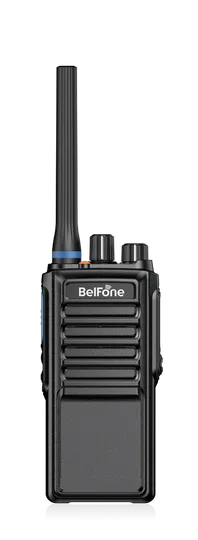
BelFone BP-620
A professional DMR handheld to include in digital fleet comparisons. The manufacturer lists an IP68 rating and a 2,000 mAh battery, subject to the exact equipment variant.
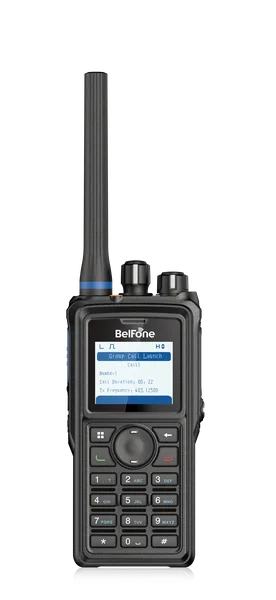
BelFone BP-660
Another professional digital radio option with configurable communications and channel management. Official specifications list IP68 protection and capacity for 1,024 programmable channels; operating capabilities depend on configuration.
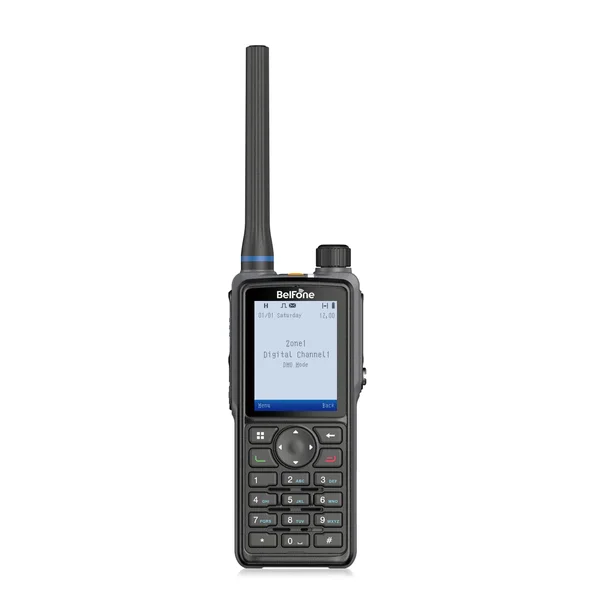
BelFone BP-860
A digital handset worth assessing where more advanced operational and management capabilities are relevant, including location-related features and selected battery and accessory options, depending on the exact variant.
For teams operating across cities through cellular data, the BelFone BF-SCP810 multimode radio may also be worth studying, subject to operator coverage, platform availability, and configuration suitability.
10. Calculate total solution cost—not handset price alone
Two quotations can look similar on unit price while differing significantly in real delivery cost. Request a breakdown of handsets, approved batteries and chargers, audio accessories, programming, any applicable frequency authorizations, repeaters, antennas, installation, coverage tests, maintenance, warranty, and training.
Ask about service and replacement plans, spare parts, additional handset lead times, responsibility for reprogramming, and the timetable for delivering a working system. A cheaper radio fleet with poor support or untested coverage can create more disruption than it saves.
11. Check the Saudi regulatory requirements
Radio equipment and spectrum use in Saudi Arabia are subject to requirements from the Communications, Space & Technology Commission (CST). Frequency permissions, equipment-related approvals, and operating requirements depend on the service, radio type, spectrum, and intended use. CST provides radio frequency licensing services and a framework of radio spectrum regulations.
Never assume a “license-free” label applied in another market automatically applies in Saudi Arabia, or that purchasing a handset authorizes operation on any chosen channel. Confirm the applicable authorization path, permitted frequencies, and equipment compliance before purchase and commissioning.
12. What to include in a useful radio quotation request
Providing a concise technical brief allows suppliers to propose a better-matched solution:
- City, facility type, operating area, and number of buildings or floors.
- Number of radios, simultaneous users, shift schedule, and spare-unit needs.
- Required departments, talk groups, and emergency procedures.
- Existing equipment models and any authorized channels or frequencies.
- Working conditions: noise, dust, moisture, hazardous zones, and field operations.
- Accessories, installation, maintenance expectations, and approximate budget range.
The bottom line: the right business radio is the one that delivers reliable communication in your actual operating area, meets licensing and compatibility requirements, remains supportable, and fits the total solution budget. A longer specification sheet alone does not make a better choice.
Frequently asked questions
How many radios should our company buy?
Start with users active on the same shift, then add suitable spare handsets, batteries, and chargers. Total employee headcount is not necessarily the correct radio quantity.
Does higher transmit power always mean better range?
No. Frequency, receiver sensitivity, obstructions, antennas, infrastructure, and regulatory power limits materially affect usable coverage. A site survey is preferable to assumptions.
Should we choose DMR or PoC?
DMR is worth evaluating for dedicated site-based RF networks; PoC may suit teams across multiple cities with reliable data coverage. Hybrid architectures may also be appropriate. Compare both technical and operational dependencies.
Do businesses need licensing to operate two-way radios in Saudi Arabia?
The answer depends on the radio service, equipment, spectrum, and use case. Review the relevant CST requirements for the proposed system before purchasing and operating radios.
Need two-way radios that fit your operations?
Share your number of users, location, facility type, and coverage requirements. Wireless Signal can help assess the equipment, programming, RF infrastructure, and support required for a practical technical and commercial quotation.
Engineering and regulatory references
- CST — Radio Frequency Licenses.
- CST — Regulations for the Use of Radio Frequency Spectrum.
- ETSI TR 102 398 — DMR Overview.
- BelFone — BP620 specifications.
- BelFone — BP660 specifications.
- BelFone — BP860 specifications.
This guide is educational. Exact coverage, model suitability, and applicable regulatory authorizations must be verified for each deployment. Features and accessories vary by model variant.