
The decision explored here is Amateur and Adventure Two-Way Radios in Saudi Arabia: A Practical Guide. Understand amateur radio licensing, adventure communications, device choices and Saudi regulatory checks before transmitting.. The right result depends on the real working environment, technical evidence and how the equipment will be operated and maintained—not simply the longest specification list or a brochure claim.
Wireless Signal approaches this subject as a practical engineering and procurement problem. The following sections distinguish verified equipment capabilities from assumptions, set out the site checks that matter, and explain how to ask a supplier for a proposal that can be tested and accepted. Application, frequency assignment and availability must be checked for each actual deployment.
1. Amateur, recreational and professional services differ
An adventure group may want short-distance coordination, a licensed amateur may experiment on authorized amateur bands, and a security company may use a professional private radio network. Similar-looking handsets do not make these services interchangeable. Identify the actual radio service, frequencies, power and purpose before buying or transmitting.
2. Saudi amateur radio has qualification requirements
CST provides an amateur radio qualification examination service and amateur radio licensing. Its official information states that passing the qualifying examination is required before obtaining an amateur license, with eligibility conditions under the current rules. Check the latest portal procedures, age and residency requirements and fees rather than relying on foreign amateur frequency charts or unverified licensing advice.
3. Adventure groups need practical safety procedures
In desert or mountain trips, a portable radio should not be marketed as a guaranteed replacement for emergency services, navigation or an agreed rescue plan. Hills and terrain can block RF paths. Establish routes, meeting points, battery reserves and backup communication, and inform a trusted party of travel plans. Any transmit frequencies must match the applicable Saudi service authorization.
4. Product form does not determine legal use
A manufacturer may advertise simple twin-pack radios or multi-band handhelds in different markets, but those pages do not establish lawful operation for every variant in Saudi Arabia. Distinguish amateur service equipment, permitted short-range devices and professional land-mobile radios. Obtain verified information about frequencies, power, exact variant and licensing before use.
5. Train users and prepare batteries and backup
Before departure, test communication under representative terrain conditions, agree call procedures and lost-contact actions, and verify battery charging and spares. Plan water, navigation, weather information and other appropriate emergency communication options. Do not assume higher power is authorized or that it overcomes all terrain obstructions. Respect other spectrum users and follow current local regulations.
6. Technical decision matrix
A useful comparison matrix for Amateur and Adventure Two-Way Radios in Saudi Arabia: A Practical Guide should record evidence rather than assign points solely from brochures. The following five checks align the technical discussion with a testable procurement decision.
| Evaluation area | Evidence required | Acceptance principle |
|---|---|---|
| 1. Amateur, recreational and professional services differ | Request model-specific evidence, a configuration screenshot or field measurement. | Pass only when the required operation can be demonstrated and supported. |
| 2. Saudi amateur radio has qualification requirements | Request model-specific evidence, a configuration screenshot or field measurement. | Pass only when the required operation can be demonstrated and supported. |
| 3. Adventure groups need practical safety procedures | Request model-specific evidence, a configuration screenshot or field measurement. | Pass only when the required operation can be demonstrated and supported. |
| 4. Product form does not determine legal use | Request model-specific evidence, a configuration screenshot or field measurement. | Pass only when the required operation can be demonstrated and supported. |
| 5. Train users and prepare batteries and backup | Request model-specific evidence, a configuration screenshot or field measurement. | Pass only when the required operation can be demonstrated and supported. |
7. Seven steps to evaluate and deploy the solution
For Amateur and Adventure Two-Way Radios in Saudi Arabia: A Practical Guide, start with a site-specific design rather than ordering by product family alone. The plan below makes different supplier proposals comparable and creates a defensible handover record.
- Identify the exact people, departments, sites, shift patterns and critical calls covered by the requirement.
- Document which equipment functions must work from day one and which are merely desirable.
- Confirm authorized frequency assignments or network service dependencies before choosing a specific device variant.
- Pilot the proposed equipment in representative hard-to-reach or high-noise locations, with calls in both directions.
- Define performance acceptance criteria, failure behavior, spare devices and emergency procedures with the operations team.
- Compare complete hardware, accessories, infrastructure, programming, training, warranty and ongoing service costs.
- Retain signed acceptance results and configuration records, and repeat tests whenever the site or network changes.
8. Common decision mistakes to avoid
- Treating an international product specification as automatic permission to operate at that frequency or output power in Saudi Arabia.
- Assuming a radio feature or software option shown on one version is present on every hardware variant.
- Using advertised range, channel memory or speaker wattage as a substitute for coverage and operational tests.
- Comparing equipment price alone while omitting accessories, repairability, programming, training and infrastructure.
- Declaring the project complete before testing the hardest locations, busy shifts and credible failure conditions.
Engineering principle: Amateur, recreational and professional services differ matters only when its effect is demonstrated in the intended operation. Test performance, verify legal use and keep a written basis for the purchasing decision.
9. BelFone equipment worth evaluating
The models below are examples for comparing available solutions, not an assertion of guaranteed availability or automatic interoperability. The exact band, accessories, configuration and suitability must be verified for the project.
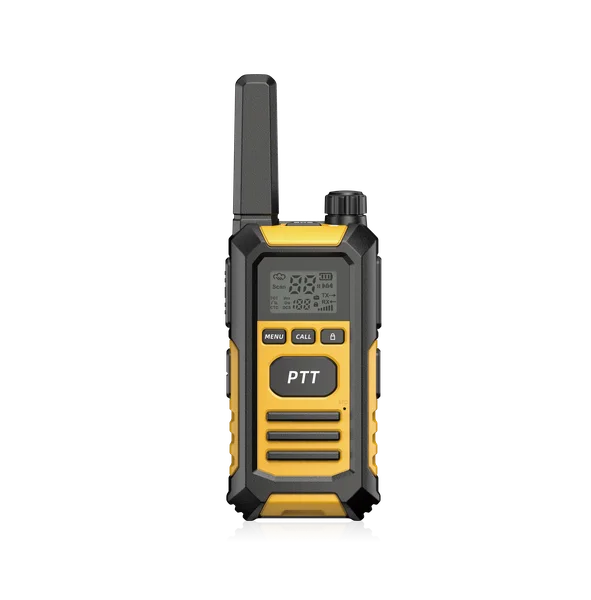
BelFone OG300
General-use product family; overseas license-free marketing does not establish Saudi spectrum exemption.
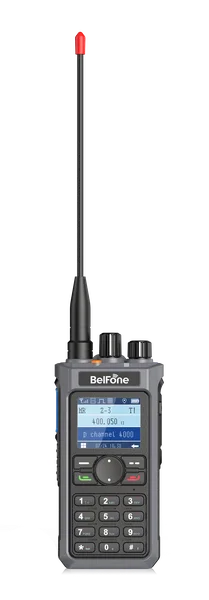
BelFone TD588UV
Radio model requiring exact band-variant and Saudi operating-rule verification before use.
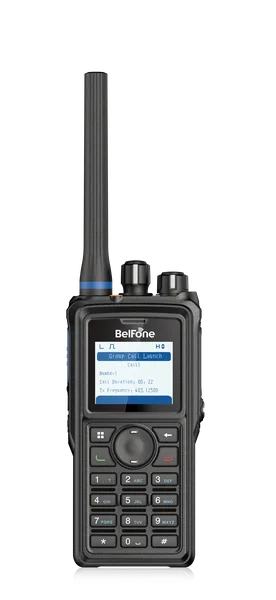
BelFone BP-660
Professional DMR handheld with band-specific variants; published IP68 protection and 2,000mAh battery, with practical range to be field-tested.
10. Saudi regulatory and operating checks
Saudi radio frequency use is regulated according to service and application by the Communications, Space & Technology Commission (CST). A manufacturer's globally listed frequency band, power rating or marketing claim does not by itself authorize operation on a chosen channel. Check the applicable service classification, any required frequency assignment or equipment approvals, and current import and operating conditions before purchasing or transmitting.
Operational success also depends on reliable support, staff training, safe battery handling and documented maintenance. The technical acceptance plan should be adjusted to the application's actual risk, including the impact of missed calls or infrastructure failure.
Frequently asked questions
Can anyone transmit on Saudi amateur bands?
No. Qualification, licensing and current CST conditions apply.
Can a trip radio replace emergency services?
No. Use a documented safety plan and backup communications.
Is every OG300 automatically license-exempt locally?
Do not rely on global marketing; check the exact variant and local rules.
Do published device specifications alone guarantee results for this project?
No. Exact variants, site coverage, operational capacity, permissions and user procedures must be verified together before acceptance.
Need a site-specific technical assessment?
Send us the city, site layout, number of users, existing radios and required services. Wireless Signal can help define a compliant equipment shortlist, coverage test and practical quotation.
Technical and regulatory references
- CST — Amateur Radio Licensing
- CST — Amateur Radio Examination
- CST — Special Telecommunication Device Regulations
- CST — Radio Frequency Licenses
Educational material only: not a frequency license, product availability confirmation, guaranteed range or site-specific safety approval. Verify the applicable documents and deployment conditions.