
When buying two-way radios for a security team, industrial plant, logistics warehouse, or construction site, suppliers may offer both VHF and UHF versions of a model. The best option is not necessarily the one advertised as stronger or longer-range. It is the frequency band that fits your actual site, authorized frequencies, antenna system, and RF infrastructure.
This guide explains the two ranges, their practical differences in open areas and complex buildings, and the role of repeaters and antenna placement. It then reviews documented band variants of BelFone professional radios and outlines what a Saudi business should check before placing an order.
1. What do VHF and UHF mean?
VHF means Very High Frequency, while UHF means Ultra High Frequency. The International Telecommunication Union recommendation ITU-R V.431-9 identifies VHF as 30–300 MHz and UHF as 300–3000 MHz. These are classifications within the overall radio spectrum, not lists of channels that every business may use.
Professional handheld radios often offer specific frequency variants, such as 136–174 MHz for a VHF version or selected UHF variants such as 400–480 MHz. A manufacturer's catalogue may show multiple variants, but that does not imply all are available in every market or legally usable without authorization in Saudi Arabia.
An important distinction: VHF and UHF describe frequency ranges. Analog FM and DMR describe radio communication technologies. Analog and digital handsets may exist in either band, depending on the exact model and version.
2. Why do frequency and wavelength affect antennas?
As frequency increases, radio wavelength decreases. For an illustrative comparison, a 150 MHz signal has a wavelength of approximately 2 meters, while at 450 MHz it is around 67 centimeters. This affects the electrical dimensions of practical antennas and some aspects of how RF signals interact with structures.
UHF handheld designs can sometimes use more compact antennas, whereas an efficient VHF antenna may require a larger electrical structure for comparable performance. However, the visible length of an antenna is not enough to judge its quality. Antenna efficiency, matching, installation, mounting position, and its suitability for the operating band all matter.
Do not install an antenna that is not designed for the radio's operating frequency. In fixed systems in particular, matching and feed-line losses should be evaluated by an RF engineer. An unsuitable antenna can compromise the transmitted signal and may affect the transmitter.
3. VHF vs UHF: practical comparison table
| Factor | VHF | UHF |
|---|---|---|
| International band definition | 30–300 MHz | 300–3000 MHz |
| Typical professional handheld variant | 136–174 MHz | 400–480 MHz and other model-specific ranges |
| Wavelength | Longer than that of higher-frequency UHF | Generally shorter |
| Open terrain | Can be an effective candidate with suitable antennas and coverage | Can also perform well with appropriate system design |
| Buildings and obstacles | Highly dependent on the material, shape, and frequency | May suit some complex environments but is not universally superior |
| Portable antennas | May require a larger electrical antenna structure | Can permit more compact designs in some applications |
| Range | No guaranteed distance based on the band alone | No guaranteed distance based on the band alone |
| Saudi authorization | Depends on service and assigned frequency | Depends on service and assigned frequency |
These comparisons are engineering considerations, not measurements for a particular installation. Frequency by itself cannot establish usable coverage or voice quality.
4. Is VHF always better for open land or desert sites?
VHF can be a suitable option for certain open areas where antennas have a relatively clear path. Different frequencies experience different propagation losses, diffraction, and interactions with obstacles. These effects matter alongside antenna height, permitted output power, receiver performance, and the site's physical geography.
Nevertheless, a VHF handset does not automatically reach farther than a UHF handset. Mountains, raised terrain, tall structures, and metal equipment can block either system. In many cases, antenna repositioning or a properly designed repeater is a more useful solution than changing bands.
For road contractors, extended industrial facilities, farms, or outdoor maintenance teams, start with a map of the required communication area and inspect the critical paths. A representative RF site test will give a more reliable answer than a generic claim that one band is “best outdoors.”
5. Does UHF always penetrate buildings better?
It is common to hear that UHF is always better indoors, but that is an oversimplification. A UHF system can be a practical choice for some dense urban or multi-room environments. Actual results, however, depend on wall materials and thickness, steel racks, basement construction, openings, reflection paths, and multipath conditions.
Some construction materials may attenuate higher frequencies more strongly; other environments may benefit from different reflection paths or smaller antenna designs. Neither band universally penetrates concrete, steel, and other obstacles better in every installation.
For shopping centers, factories, hotels, and warehouses, test the lower floors, elevators, narrow service corridors, and rows of storage racking. If significant dead spots appear, the next step may be a better repeater and antenna layout rather than assuming another frequency band will fix the issue.
6. What has a bigger impact on coverage than the band name?
- Line of sight and obstructions: terrain, hills, buildings, and metal machinery can weaken or interrupt paths.
- Antenna positioning: well-placed antennas often improve the system more than simply increasing output power.
- RF components: proper antenna gain and tuning, cable losses, and sound connectors are all important.
- Equipment and settings: receiver sensitivity, permitted transmit power, digital or analog mode, programming, and interference.
- Network design: direct radio-to-radio service versus repeaters, coverage redundancy, and number of sites.
Engineering recommendation: do not buy a large fleet based on claims such as “five kilometers of range.” Request RF measurements in critical areas and document the successful and unsuccessful coverage locations before acceptance.
7. How should different industries evaluate the bands?
| Industry | Initial engineering considerations | What to verify |
|---|---|---|
| Outdoor projects and large open sites | Line of sight, terrain, longer pathways; VHF may be worth evaluating | UHF may still be appropriate based on design and authorization |
| Warehouses and logistics | Steel racks, vehicle traffic, obstructions; survey the candidate options | Never assume one band is better without site tests |
| Hotels and shopping centers | Multiple floors, basements, elevators, maintenance corridors | In-building repeaters and antennas may determine success |
| Industrial plants | Separate buildings, machinery, operational noise, dense metal structures | Test coverage and consider safety and device ruggedness |
| Security and guarding | Property perimeter, remote posts, separate talk groups | Radio planning and frequency permissions are critical |
8. Can a VHF radio communicate directly with a UHF radio?
Not normally. A VHF-only handset cannot directly communicate with a UHF-only handset merely because both use the same manufacturer or support DMR. The operating frequency, mode, channel parameters, and other settings must be compatible.
Specialized gateways, repeaters, or network bridges can sometimes interconnect different systems, but these require additional design and correctly authorized operation. Likewise, a catalogue listing both VHF and UHF options for a model does not prove that one physical handset supports both bands. They may be entirely separate hardware variants.
9. Compare BelFone professional radio variants
BelFone publishes VHF and UHF variants of the BP-620, BP-660, and BP-860. The exact band-specific version must be confirmed during specification and quotation. Manufacturer-listed frequency ranges describe possible versions, not a promise of local stock or authorization to operate on every frequency in Saudi Arabia.
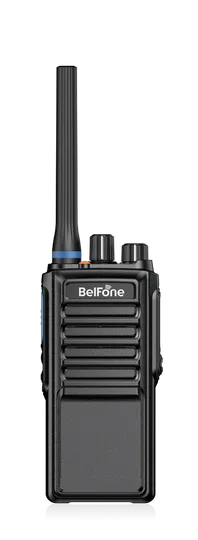
BelFone BP-620
Published frequency options include VHF 136–174 MHz and UHF 350–400 / 400–480 MHz variants. It is an example to assess for business teams after the band and coverage requirements have been defined.
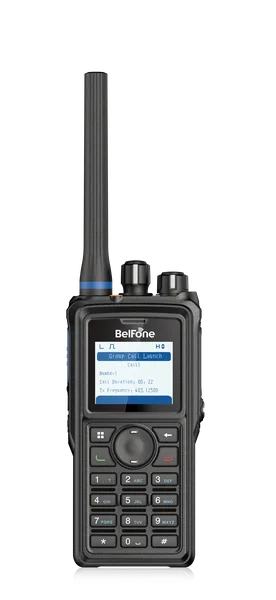
BelFone BP-660
The manufacturer's specifications list VHF 136–174 MHz and multiple UHF options for different versions, alongside professional digital radio features. Verify the ordered model's specific frequency range.
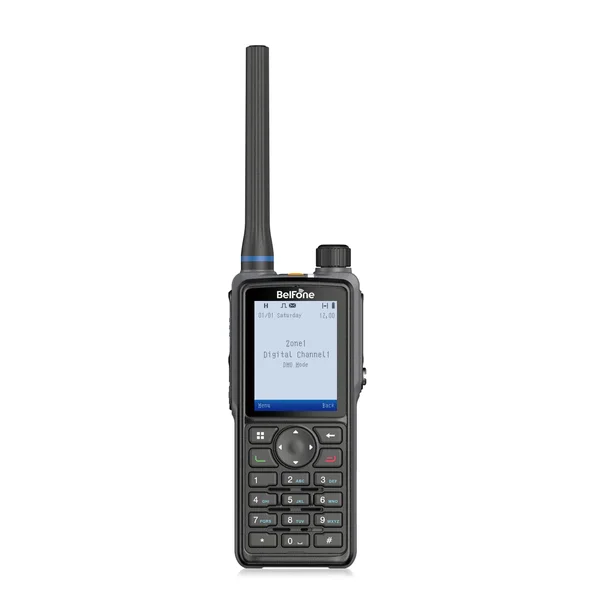
BelFone BP-860
BelFone also specifies a VHF 136–174 MHz version and several UHF variants for this model. It can be assessed for projects requiring additional functionality, provided the version, accessories, and RF system are correctly matched.
Before choosing, share your authorized or proposed frequency information, business location, site type, and number of users with Wireless Signal. We can help evaluate suitable radio variants, antennas, repeaters, programming, and the required system scope.
10. Which VHF and UHF frequencies are authorized in Saudi Arabia?
The VHF or UHF label is only a starting point. Actual frequency assignments, radio-equipment requirements, and operating permissions in Saudi Arabia are governed by the Communications, Space & Technology Commission (CST). Its Radio Frequency Licenses service and radio spectrum regulations provide the official regulatory framework.
The relevant authorization depends on the radio service, specific frequency, equipment, and intended operation. Being inside the VHF or UHF spectrum does not make a channel available for general corporate use, and buying an internationally marketed handset does not authorize transmission on any chosen frequency in the Kingdom.
11. A practical checklist for an RF quotation
- Specify the city, site layout, coverage area, and number of buildings and floors.
- Describe the environment: open land, warehouse, factory, basement, or mobile field teams.
- List user and handset counts, talk groups, shift lengths, and emergency needs.
- Provide existing network details, device models, and any assigned frequencies or permits.
- Request representative RF site tests at the most challenging locations.
- Confirm the band-specific radio variant, antennas, programming, repeaters, accessories, support, and warranty.
The bottom line: there is no universal winner between VHF and UHF. Choose the band that fits the applicable spectrum authorization and provides dependable coverage in the real facility, supported by the right radios, antennas, and network design.
Frequently asked questions
Does VHF always have longer range than UHF?
No. Lower frequencies can have advantages in some settings, but range also depends on line of sight, terrain, antenna design, permitted transmit power, interference, receiver performance, and repeaters.
Is UHF always better inside buildings?
No. UHF can be appropriate for many indoor environments, but the outcome varies with construction materials, metal obstacles, antenna positions, and RF design. On-site testing is recommended.
Can one BP-660 radio work on VHF and UHF together?
BelFone lists several band variants for the BP-660 model. That does not establish that a single physical version operates on both bands. Confirm the manufacturer's exact variant code before ordering.
Can two DMR radios communicate across VHF and UHF without extra equipment?
Not normally. DMR compatibility alone does not solve different operating frequencies. Suitable radios must use compatible spectrum and channel settings, or a purpose-built bridge may be required.
Need help choosing the right frequency band?
Tell Wireless Signal about the location, site size, user count, and any existing radio system or assigned channels. We can evaluate suitable BelFone variants and RF coverage options before preparing a project quotation.
Technical and regulatory references
- ITU-R V.431-9 (2025) — Frequency band nomenclature.
- CST — Radio Frequency Licenses.
- CST — Regulations for the Use of Radio Frequency Spectrum.
- BelFone — BP-620 official specifications.
- BelFone — BP-660 official specifications.
- BelFone — BP-860 official specifications.
For education only. Coverage and compliance must be evaluated for the actual site. Product frequency ranges are manufacturer-specific variants and require confirmation before purchase or operation.