
Portable two-way radios often work in direct mode: one radio transmits, and other radios within useful range hear the call without relying on a fixed intermediate station. But what happens when a team is separated by reinforced concrete, large warehouse racks, several buildings, or challenging terrain? A correctly planned radio repeater may extend the practical communication area by receiving a signal at a suitable site and transmitting it again for other users.
A repeater is not a magical fix for every weak signal. Nor does a higher advertised transmitter power guarantee that portable radios will be heard across the whole site. This guide explains the engineering behind repeaters, the decisions involved in installing them, and how a professional BelFone solution may fit Saudi operations.
1. What is a two-way radio repeater?
A radio repeater is an intermediate fixed station that receives a transmission from a portable or mobile radio and retransmits the communication through an appropriate output channel. It lets radios that cannot reliably hear each other directly communicate through the repeater, provided each unit has a viable link to the repeater site.
Many conventional professional land-mobile repeater systems use separate receive and transmit frequencies, known as a duplex pair. The frequency separation is sometimes called the duplex offset. There is no universally correct offset for all bands and services; the actual assignment must match the permitted frequencies, system architecture, and filter hardware.
More specialized designs can support networked systems or same-frequency simulcast arrangements. Such functionality depends on the specific equipment, licenses, and engineering design and is not implied automatically by the label “DMR repeater.”
2. How does a call travel through a repeater?
- Someone in the first area presses PTT on a programmed radio, transmitting on the repeater's input channel.
- The repeater receives the signal through its RF front end, antenna system, and the correct channel configuration.
- The repeater transmits the call on the designated output channel for all radios monitoring the relevant network.
- When another team member responds, the process repeats. Configured talk groups can keep departments separate within the system's real capacity.
Real-world example: an employee at the back of a metal-rack warehouse cannot directly reach the guard at a distant entrance. If both radios can transmit to—and receive from—a well-sited repeater, the teams may communicate through it. Hearing the repeater clearly is not proof that the weaker handheld can transmit back to it.
3. Direct mode, repeaters, base stations, and cellular push-to-talk
| Option | How it works | When to evaluate it |
|---|---|---|
| Direct Mode | Portable and mobile radios talk without an intermediate radio site | Small teams with adequate direct coverage |
| Base Station | Fixed operating position for a dispatcher, security desk, or control room | Sites needing a permanent communications operator |
| Conventional Repeater | Receives and retransmits traffic from system users | Users separated by obstacles or poor direct coverage |
| Linked Repeaters | Several compatible repeater sites connected through a suitable backbone | Multiple buildings or geographically separated facilities |
| Push-to-Talk over Cellular (PoC) | Communication delivered using a mobile data service and platform | Distributed teams with reliable cellular data coverage |
Some projects combine more than one method. A generic RF “signal booster” or power amplifier is not automatically equivalent to a professional repeater and should not be inserted into a radio system without technical evaluation and regulatory authorization.
4. When does your facility actually need a repeater?
- Distribution and warehousing: communications drop behind metal shelving or at remote loading docks.
- Manufacturing plants: separate buildings, maintenance rooms, and machinery interrupt direct radio paths.
- Hotels and shopping malls: operational groups need dependable communication across floors, back-of-house areas, and basements.
- Construction projects: changing work areas, heavy equipment, and expanding facilities create new coverage gaps.
- Logistics hubs: site security, warehouse staff, dispatch, yards, and gates need dependable coordination.
However, a failing battery, defective antenna, poor programming, or inappropriate frequency assignment will not necessarily be fixed by buying a repeater. Test the existing system first, identify the real cause of weak communications, and set measurable coverage objectives.
5. What equipment makes up a repeater installation?
A site typically includes a properly configured repeater, one or more antennas according to the system design, low-loss feed cables, connectors, suitable grounding and lightning protection, and a stable power supply. Depending on the installation, a duplexer isolates the sensitive receiver from the transmitter while allowing a shared antenna.
A duplexer is not simply a cable splitter. It is an RF filtering and isolation system that must be suitable for the actual transmit and receive frequencies, transmitter power, and channel separation. Insufficient isolation may allow the local transmitter to overwhelm its own receiver and reduce sensitivity, a problem called receiver desensitization.
The engineering team should determine an appropriate antenna site, cable length, grounding arrangements, environmental requirements, ventilation, monitoring, and backup power. A very high installation location is not necessarily optimal if it introduces interference or poor paths to critical areas.
6. How does a DMR digital repeater work?
The conventional DMR Tier II standard uses a two-slot TDMA approach within a 12.5 kHz radio channel. In a suitably equipped conventional network, the two logical time slots may carry separate communications, enabling more efficient use of the assigned RF channel than a single-call arrangement.
Two time slots do not automatically mean double the RF range or two extra licensed carrier frequencies. Nor do they guarantee two simultaneous calls in every configuration. Real operational capacity depends on equipment capabilities, talk-group programming, slot allocation, system loading, and network mode.
Keep the DMR air-interface standard separate from optional features such as networking, roaming, simulcast, encryption, and dispatch integration. The exact radio, repeater, firmware, licensing, and interface compatibility must be verified for each required feature.
7. Why does a repeater not solve every coverage problem?
A repeater can offer a better located transmitting and receiving point. It cannot remove concrete walls, terrain obstructions, metal structures, or radio interference. For a two-way conversation to work, the user's handset needs a viable uplink to the repeater and a usable downlink from it.
A high-power repeater could be audible a long way away while still being unable to receive a low-power handheld transmitting from a basement. That is why professional surveys assess both directions and review antenna placement, line losses, and interference. Some sites are best addressed through a repositioned antenna, while others need additional repeater locations or a distributed antenna design.
8. How do you plan a professional repeater project?
- Define the coverage map: identify buildings, yards, floors, basements, access gates, and emergency points.
- Survey the current RF environment: record direct-mode success and failure points, interference, and relevant site constraints.
- Validate frequency permissions: check allowed bands, frequency assignments, equipment variants, and applicable authorizations.
- Assess site placement: select feasible antenna positions, power access, safety measures, and suitable environmental conditions.
- Size network capacity: estimate simultaneous callers, talk groups, shifts, and future expansion.
- Check compatibility: handsets, repeater, timeslots, programming, RF filters, accessories, and any network connections.
- Set acceptance criteria: conduct bidirectional field tests in challenging locations and document both results and ongoing support.
Procurement tip: request a scope that covers antennas, duplexer, installation, cables, programming, commissioning, training, warranty, and acceptance testing. The price of the repeater unit alone is not the total cost of a commissioned network.
9. Product example: BelFone BR1050 professional DMR repeater
The BelFone BR1050 provides a useful example of a professional digital repeater in a slim 1U rack-mountable form factor. BelFone lists output power of up to 50 W, 99 programmable channels, and manufacturer variants for VHF 136–174 MHz and UHF 350–400 / 400–480 / 450–520 MHz. Confirm the exact equipment variant and radio settings before purchase.
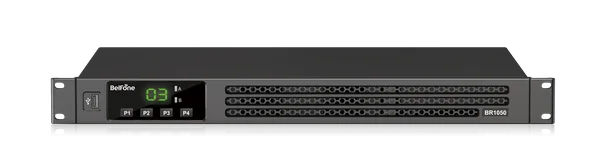
BelFone BR1050
Manufacturer-listed maximum output of 50 W and main plus backup power options. Final installation requires appropriate site design, antenna systems, transmitter-receiver isolation, programming, and Saudi regulatory compliance. Maximum output is not automatically the permitted or necessary setting at every site.
Handheld user radios must also be assessed. A system sharing the DMR name does not guarantee complete cross-model compatibility or support for every optional function. Check frequencies, firmware, air-interface modes, channels, colour codes, talk groups, and timeslots.
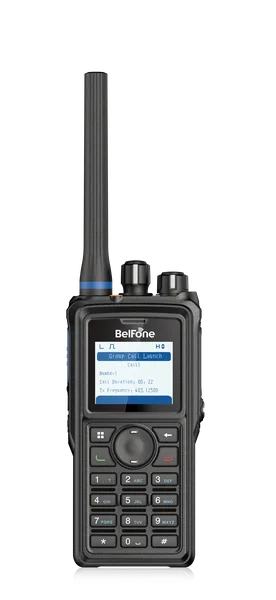
BelFone BP-660
A professional handheld option to consider in a digital radio network design, subject to validation of the band-specific variant and required channel and timeslot configuration.
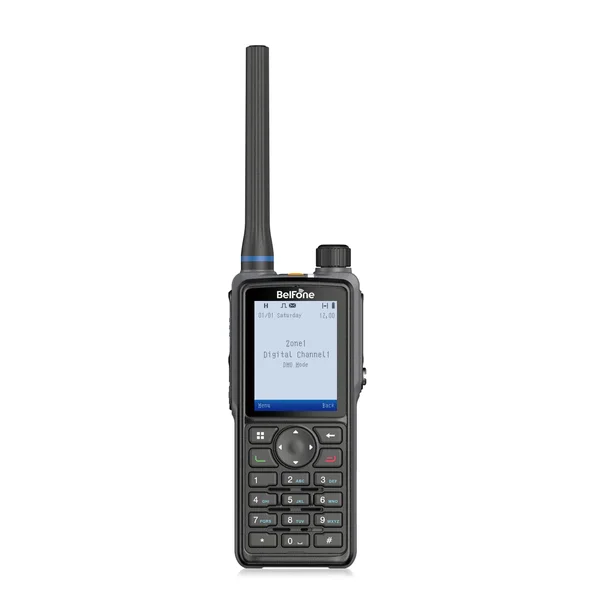
BelFone BP-860
Another handheld option for assessing the capabilities and compatibility of the user fleet in a professional site radio system, according to the chosen hardware and firmware version.
10. Does a repeater increase range, power, or capacity?
| Requirement | What a repeater may improve | What it does not guarantee |
|---|---|---|
| Coverage | Communication between sites with poor direct radio paths | Every basement or floor works without a site test |
| Useful range | A more advantageous antenna and installation location | A fixed range measured in kilometers across all locations |
| Call capacity | DMR timeslot efficiency in compatible configurations | Unlimited calls or concurrent slots in every mode |
| Multiple locations | Additional coverage when connected to suitable network infrastructure | Repeaters link themselves merely by being powered up |
| Resilience | Monitoring and backup power with the right engineering | Service under every failure or power outage |
11. Does a business repeater require licensing in Saudi Arabia?
Professional repeater installation and use are subject to the applicable radio service, assigned spectrum, equipment, and operating requirements. The Communications, Space & Technology Commission (CST) regulates spectrum use in the Kingdom. CST offers radio frequency licensing services and publishes regulations for spectrum used by radio services.
For conventional repeaters, confirm that the proposed input and output frequencies are covered by the appropriate authorization and that the equipment complies with applicable requirements. Do not treat a manufacturer's supported band or its stated 50 W output capability as permission to transmit at a chosen frequency or power level. Equipment approvals, safety and installation conditions, and applicable fees may also need review depending on the actual project.
12. What should you send when requesting a repeater quotation?
Provide the city, site plans and operational area, number of floors or buildings, current handset models, user and talk-group counts, shift patterns, existing frequencies and permits, and locations where communications currently fail. Explain any emergency communications or backup-power requirements.
Ask suppliers to state whether their proposed scope includes a site survey, radio equipment, antennas, duplexer, cables, installation, programming, acceptance tests, warranty, user training, and maintenance. This enables a fair comparison of complete system proposals rather than isolated hardware prices.
Bottom line: install a repeater when field measurements show that direct communication is insufficient and the proposed repeater site provides viable two-way access. Regulatory compliance, correct frequencies, antenna design, and dependable ongoing support matter as much as the repeater model itself.
Frequently asked questions
Do we need a repeater if our handheld radios are powerful?
Not necessarily. If the site already meets coverage needs, a repeater may add no value. If buildings or terrain block direct communication, a well-sited repeater may help, subject to a proper survey.
Can a digital repeater work with analog radios?
That depends on the repeater, exact handset variants, supported operating modes, and programming. Do not assume analog/DMR interoperability without checking manufacturer specifications and testing the proposed configuration.
Does a DMR repeater need separate receive and transmit frequencies?
Many conventional systems use a distinct repeater input and output frequency. More specialized systems may differ; the selected architecture and authorized frequency plan determine the correct arrangement.
Will a 50 W repeater cover an entire industrial facility?
Not from output power alone. Antenna location, feed losses, obstacles, interference, permitted operation, and the strength of the user's portable radio determine the practical result. Test the site before committing.
Need a radio coverage survey or repeater installation?
Tell Wireless Signal your city, site type, building plans, number of radios, and where you experience poor coverage. Our RF solutions team can help assess repeaters, antennas, network design, programming, and installation before preparing a quotation.
Technical and regulatory sources
- DMR Association — DMR Tier II, TDMA and channel spacing.
- BelFone — BR1050 official specifications.
- Tessco — Repeater duplexers and receiver isolation.
- CST — Radio Frequency Licenses.
- CST — Spectrum Regulations for Radio Services.
This guide is educational and not an installation plan or operating permit. Exact radio variants, safety conditions, spectrum permissions, and system coverage require case-specific engineering verification.