
The decision explored here is Two-Way Radios for Warehouses, Yards and Logistics Operations. Plan warehouse and logistics radio communications for forklift routes, dock loading, dispatch, yard teams and high-rack coverage.. The right result depends on the real working environment, technical evidence and how the equipment will be operated and maintained—not simply the longest specification list or a brochure claim.
Wireless Signal approaches this subject as a practical engineering and procurement problem. The following sections distinguish verified equipment capabilities from assumptions, set out the site checks that matter, and explain how to ask a supplier for a proposal that can be tested and accepted. Application, frequency assignment and availability must be checked for each actual deployment.
1. Connect receiving, put-away, picking and dispatch
Logistics teams move between receiving docks, stock locations, order picking, loading bays and yard gates. Radio groups should reflect operational workflows rather than only organizational departments. Agree short, clear calls for vehicle movement and dock allocation so that busy delivery windows do not overload a shared channel.
2. High steel racks create unpredictable RF paths
Full steel racks, lift trucks and containers can reflect or shadow signals in warehouse aisles. Survey deep storage lanes, loading doors, mezzanines and adjoining yards under realistic stock conditions. When rack layouts or storage density change, reassess the affected zones instead of assuming that an old acceptance map remains accurate.
3. Choose ergonomic and safe accessories
Gloved workers may require accessible PTT buttons or compatible speaker-microphones, while yard supervisors need shift-long endurance and reliable audio in engine noise. Check connector durability, device carrying methods and charging routines. Vehicle-installed units must be mounted safely without obstructing drivers or interfering with truck electrical systems.
4. Distinguish voice from WMS data integration
Voice PTT can expedite exception handling but does not automatically synchronize stock counts with a warehouse management system. Define any WMS or scanner integration separately, including interfaces, devices, permissions and network dependencies. Wi-Fi or mobile-data workflows may complement, rather than replace, a dependable site voice network.
5. Prove performance through measurable site acceptance
Define acceptance outcomes: calls from each gate to dispatch, usable communications along forklift routes, and available backup radios during shifts. Size capacity for busy-hour talk traffic and plan maintenance of chargers, aerial installations and spare batteries. Start with a representative survey and extend the network when layout or throughput changes justify it.
6. Technical decision matrix
A useful comparison matrix for Two-Way Radios for Warehouses, Yards and Logistics Operations should record evidence rather than assign points solely from brochures. The following five checks align the technical discussion with a testable procurement decision.
| Evaluation area | Evidence required | Acceptance principle |
|---|---|---|
| 1. Connect receiving, put-away, picking and dispatch | Request model-specific evidence, a configuration screenshot or field measurement. | Pass only when the required operation can be demonstrated and supported. |
| 2. High steel racks create unpredictable RF paths | Request model-specific evidence, a configuration screenshot or field measurement. | Pass only when the required operation can be demonstrated and supported. |
| 3. Choose ergonomic and safe accessories | Request model-specific evidence, a configuration screenshot or field measurement. | Pass only when the required operation can be demonstrated and supported. |
| 4. Distinguish voice from WMS data integration | Request model-specific evidence, a configuration screenshot or field measurement. | Pass only when the required operation can be demonstrated and supported. |
| 5. Prove performance through measurable site acceptance | Request model-specific evidence, a configuration screenshot or field measurement. | Pass only when the required operation can be demonstrated and supported. |
7. Seven steps to evaluate and deploy the solution
For Two-Way Radios for Warehouses, Yards and Logistics Operations, start with a site-specific design rather than ordering by product family alone. The plan below makes different supplier proposals comparable and creates a defensible handover record.
- Identify the exact people, departments, sites, shift patterns and critical calls covered by the requirement.
- Document which equipment functions must work from day one and which are merely desirable.
- Confirm authorized frequency assignments or network service dependencies before choosing a specific device variant.
- Pilot the proposed equipment in representative hard-to-reach or high-noise locations, with calls in both directions.
- Define performance acceptance criteria, failure behavior, spare devices and emergency procedures with the operations team.
- Compare complete hardware, accessories, infrastructure, programming, training, warranty and ongoing service costs.
- Retain signed acceptance results and configuration records, and repeat tests whenever the site or network changes.
8. Common decision mistakes to avoid
- Treating an international product specification as automatic permission to operate at that frequency or output power in Saudi Arabia.
- Assuming a radio feature or software option shown on one version is present on every hardware variant.
- Using advertised range, channel memory or speaker wattage as a substitute for coverage and operational tests.
- Comparing equipment price alone while omitting accessories, repairability, programming, training and infrastructure.
- Declaring the project complete before testing the hardest locations, busy shifts and credible failure conditions.
Engineering principle: Connect receiving, put-away, picking and dispatch matters only when its effect is demonstrated in the intended operation. Test performance, verify legal use and keep a written basis for the purchasing decision.
9. BelFone equipment worth evaluating
The models below are examples for comparing available solutions, not an assertion of guaranteed availability or automatic interoperability. The exact band, accessories, configuration and suitability must be verified for the project.
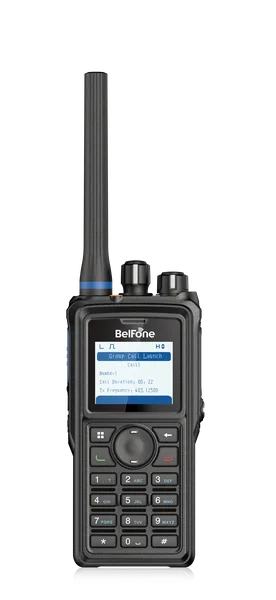
BelFone BP-660
Professional DMR handheld with band-specific variants; published IP68 protection and 2,000mAh battery, with practical range to be field-tested.
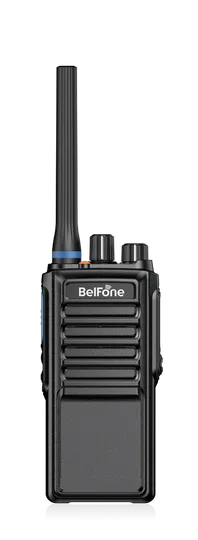
BelFone BP-620
A professional portable option for work teams; test audio, battery, real coverage and programmed compatibility before purchase.
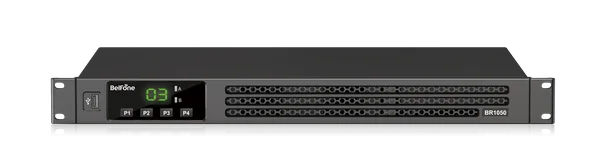
BelFone BR1050
1U professional DMR repeater with manufacturer output up to 50 W; requires authorized frequencies, antenna design and commissioning.
10. Saudi regulatory and operating checks
Saudi radio frequency use is regulated according to service and application by the Communications, Space & Technology Commission (CST). A manufacturer's globally listed frequency band, power rating or marketing claim does not by itself authorize operation on a chosen channel. Check the applicable service classification, any required frequency assignment or equipment approvals, and current import and operating conditions before purchasing or transmitting.
Operational success also depends on reliable support, staff training, safe battery handling and documented maintenance. The technical acceptance plan should be adjusted to the application's actual risk, including the impact of missed calls or infrastructure failure.
Frequently asked questions
Does every warehouse require a repeater?
No. Direct mode may suffice; decide from actual site measurements.
Can one network cover the warehouse and truck yard?
Potentially, with appropriate antenna and frequency planning and bidirectional testing.
Can radio devices connect to WMS?
Only through a defined integration; voice radio does not automatically exchange inventory data.
Do published device specifications alone guarantee results for this project?
No. Exact variants, site coverage, operational capacity, permissions and user procedures must be verified together before acceptance.
Need a site-specific technical assessment?
Send us the city, site layout, number of users, existing radios and required services. Wireless Signal can help define a compliant equipment shortlist, coverage test and practical quotation.
Technical and regulatory references
- ITU-R P.1812 — Terrestrial propagation prediction
- DMR Association — DMR Standards
- CST — Radio Frequency Licenses
Educational material only: not a frequency license, product availability confirmation, guaranteed range or site-specific safety approval. Verify the applicable documents and deployment conditions.