
“How many kilometers will this two-way radio reach?” is one of the first questions buyers ask when equipping factories, warehouses, construction projects, or security teams. Unfortunately, there is no single distance that can be guaranteed for every site. The same pair of radios may perform well across an open yard and fail behind reinforced concrete or steel racking at a shorter distance. Coverage is a property of the complete radio link—not a fixed number built into the handset.
This guide explains the factors that matter most: terrain, line of sight, radio frequency, antenna placement, transmitter and receiver performance, interference, and the network architecture. It also shows how to make evidence-based improvement decisions using examples from BelFone professional equipment and applicable Saudi requirements.
1. What does radio coverage actually mean?
Usable coverage describes the area in which a pair of radios—or a radio and repeater—can communicate at an acceptable quality under defined conditions. It is rarely a perfect circle. A long, clear radio path might work while a nearby lower floor is completely out of range because a building obstructs the signal.
Before testing, define acceptable performance: intelligible voice, successful calls in both directions, group-call capability, and communication at high-priority points during representative working conditions. Hearing only one end of a conversation is not sufficient.
2. Terrain, line of sight, and obstructions
Relatively clear radio paths usually make communication easier. Yet seeing a distant position with your eyes does not automatically mean there is a clean RF path. Hills, surrounding structures, and the space around the direct signal path can affect propagation. Engineers may examine the Fresnel zone when assessing how obstacles around the line-of-sight path influence a link.
Factories and warehouses introduce additional complexity: high steel shelves, vehicles, machinery, metal-clad walls, and enclosed corridors. Since some of these obstructions move or change during work, tests should reflect realistic operating patterns—not just an empty facility after hours.
Example: a portable radio may reach a distant site gate across an open yard yet struggle in a closer loading bay surrounded by metal. In that case, increasing output power alone may not solve the underlying obstruction problem.
3. VHF versus UHF frequency bands
Operating frequency influences wavelength, propagation losses, and how a signal interacts with obstacles. VHF can be effective in some open environments; UHF can suit certain complex industrial and urban settings. Neither band universally travels farther, and UHF does not always penetrate every building better.
The correct choice depends on the authorized frequency, the exact hardware variant, antenna design, and the measured site environment. Our VHF versus UHF technical guide explains the differences in greater detail.
4. Antenna height, gain, placement, and feed losses
Positioning a fixed-site antenna appropriately can improve radio coverage more than replacing every user handset. Antenna height and mounting location, electrical matching, gain, radiation pattern, and polarization all affect the available signal.
However, higher gain is not automatically superior in every direction. Some antennas focus energy into a different coverage shape rather than improving service uniformly. Poor connectors and excessive or low-quality feed cable may also consume much of the anticipated gain before the signal reaches the antenna or receiver.
Portable radio performance is also influenced by how the device is held, its proximity to the user's body, and whether the installed antenna is matched to the specific operating band. A physically longer replacement antenna is not automatically a better antenna.
5. Why transmitter power does not guarantee range
Transmit power is one component of a radio link budget, not a complete coverage specification. Higher output can improve transmitted signal levels under some conditions, but it cannot eliminate poor antenna placement, concrete barriers, interference, or insufficient receiver performance. Permitted transmit power also depends on the actual authorization and installation.
It is especially important to assess the uplink from a low-power portable radio to the repeater separately from the downlink transmitted by the repeater. A powerful repeater may be clearly audible to staff while it cannot hear their handheld radios in difficult areas.
6. Receiver sensitivity and equipment quality
Receiver sensitivity describes the ability to receive a weak signal under defined measurement conditions. Digital radio specifications may state sensitivity at a particular bit error rate (BER). Such numbers should be compared only when the relevant test conditions are consistent. One receiver-sensitivity figure by itself cannot characterize actual performance in noisy environments.
Receiver selectivity, immunity to interference, antenna quality, connectors, and equipment maintenance also affect reliability. A higher transmit power rating does not compensate for a poor receive chain.
7. Interference, channel planning, and traffic
At industrial campuses and in dense city districts, nearby radio systems, electronic equipment, and poorly planned frequency use can degrade communication. Co-channel or adjacent-channel interference may affect intelligibility and call completion. Separately, too many talk groups sharing limited capacity can cause congestion even where the received signal is strong.
The solution is not always a new handset. Assess the local RF environment, frequency assignments, channel loading, and the compatibility of the analog or DMR programming with the wider network. All changes must remain within applicable spectrum authorizations.
8. Building materials, weather, and operating behavior
Indoor propagation depends on construction materials, concrete reinforcement, reflective surfaces, doors, partitions, and multipath behavior. Outdoors, terrain and vegetation may affect radio paths depending on the operating frequency and conditions. Rain or weather should not be assumed to be the dominant factor for every short VHF/UHF link; in many everyday cases, obstacles, terrain, and antennas are more important, though specialized conditions can differ.
Coverage can also change when a user moves into a lift or vehicle, holds the handset against their body, or stores it in a pocket or under clothing. Test representative ways of carrying and using equipment.
9. At a glance: what changes coverage and how to check it
| Factor | Possible effect | What to verify |
|---|---|---|
| Terrain and line of sight | Blocked or degraded pathways | Tests behind hills and buildings |
| Wall materials | Attenuation and reflections | Indoor floors, basements and service areas |
| Frequency band | Different loss and obstacle behavior | Authorized candidate radio variants |
| Antenna placement | Improved or weakened site coverage | Compare feasible mounting positions |
| Antenna pattern and polarization | Different distribution of useful signal | Gain, pattern, installation alignment |
| Cable and connector losses | Less signal reaches the antenna or radio | Feed-line loss and connector inspection |
| Transmitter power | Changed transmitted signal strength | Authorized setting and return-path performance |
| Receiver performance | Ability to receive weak transmissions | Comparable specifications and bench tests |
| Interference and congestion | Distortion, missed calls or blocking | Spectrum monitoring and channel plan |
| How users carry radios | Antenna interaction with the body | Practical operating posture and locations |
10. What is a link budget?
A radio link budget combines transmit power and antenna gains, and accounts for cable, propagation, obstruction, and other losses. The predicted signal at the receiver is evaluated against its sensitivity requirements and a fading margin appropriate to the reliability target.
Calculations are useful for identifying the causes of poor coverage, but their accuracy depends on the selected propagation model and input data. The ITU's ITU-R P.1812 recommendation addresses terrestrial propagation prediction, while ITU-R P.1238 addresses indoor environments. Model-based estimates still require field validation for the actual project.
11. When should you add a base station or repeater?
When direct communication fails even after defective equipment, mismatched antennas, and programming problems are ruled out, a fixed station or radio repeater at an appropriate location may improve the network. But the handheld must be able to transmit back to the repeater, not merely hear its output. Complex multi-building sites may require multiple sites or distributed antenna arrangements.
Also plan for the number of simultaneous users, talk groups, backup power, and maintenance. Read our previous professional repeater guide for the infrastructure and licensing considerations.
12. BelFone radio and repeater examples
The right model should be selected from the site's requirements, not from a generic range claim. Professional DMR radios such as BelFone BP-660 and BP-860 may be assessed alongside a BR1050 repeater if measured coverage warrants one. The correct frequency variant, programming, compatibility, regulatory permissions, and product availability must be confirmed before supply.
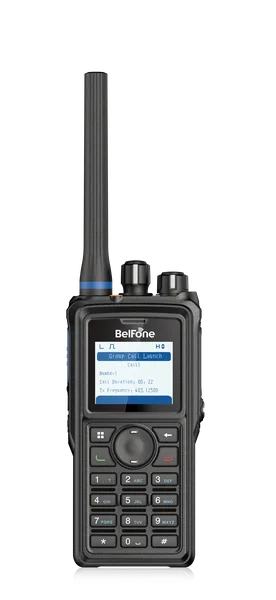
BelFone BP-660
A professional digital handset with manufacturer-listed VHF and UHF variants. BelFone specifies transmitter power below 5 W and a digital sensitivity test condition of 5% BER; neither figure establishes a guaranteed number of kilometers of coverage.
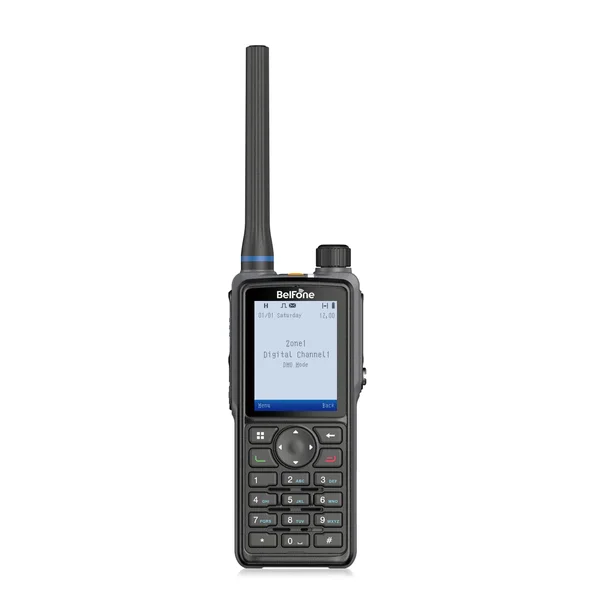
BelFone BP-860
Another professional digital radio option for site-based evaluation. Its useful coverage depends on the selected hardware version, antenna, interference, terrain, and the planned network.
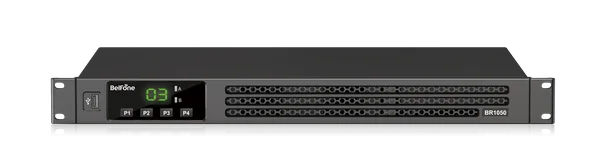
BelFone BR1050
A 1U professional repeater with maximum manufacturer-listed output no greater than 50 W. The rated output does not mean a guaranteed range or automatic permission to transmit at maximum power. Antenna design and the handheld's return path remain essential.
13. How to conduct a professional radio coverage survey
- Map the required service points: floors, basements, yards, loading areas, corridors, and emergency locations.
- Define radio and simultaneous-user counts, operational groups, and the minimum acceptable voice performance.
- Review the currently authorized frequencies, model variants, programmed channels, and existing antennas.
- Test both directions of communication at difficult locations and during representative operating conditions.
- Document where coverage succeeds or fails; do not limit tests to the office or car park entrance.
- Compare remedies: equipment maintenance, programming, better antenna placement, repeater sites, or a multi-site architecture.
- Perform post-installation acceptance testing and agree on maintenance, support, and future expansion.
Procurement tip: ask for a realistic coverage map and documented acceptance criteria. Treat unsupported blanket promises of a particular kilometer range with caution.
14. What are the Saudi regulatory considerations?
Radio frequencies, equipment variants, transmitter power and repeater operation may be subject to requirements of the Communications, Space & Technology Commission (CST), depending on the actual service and use case. CST provides radio frequency licensing services. A frequency or power figure appearing in a global product brochure does not automatically authorize operation under those conditions in Saudi Arabia.
Frequently asked questions
How many kilometers can a five-watt radio cover?
No guaranteed range can be calculated from power alone. Frequency, antennas, obstacles, interference, receiver performance, operating conditions, and authorization all matter. A site survey gives a more realistic assessment.
Will replacing the antenna always extend coverage?
A correctly selected antenna or improved placement can help, but results vary with gain, radiation pattern, frequency, cable loss, and the site. Changes should be tested rather than assumed.
Why can I hear the repeater when it cannot hear me?
The repeater may have a stronger or better-placed transmitter, while the portable radio's weaker uplink fails to reach it. Both directions of the link must be measured.
Is VHF or UHF always the better choice for range?
Neither is universally superior. The permitted frequency assignments, physical environment, antennas, and on-site measurements should drive the choice.
Want to measure coverage at your facility?
Tell Wireless Signal your city, site layout, number of radios, and locations with unreliable communication. Our RF team can evaluate antenna, handheld and repeater options and prepare a suitable technical and commercial quotation.
Technical and regulatory references
- ITU-R P.1812-8 — Terrestrial point-to-area propagation predictions.
- ITU-R P.1238-13 — Indoor radio propagation.
- ITU-R P.1411-13 — Short-range outdoor radio propagation planning.
- BelFone — BP-660 official specifications.
- BelFone — BR1050 official specifications.
- CST — Radio Frequency Licenses.
Educational information only. It is not a guaranteed range statement, project-specific installation design, or operating authorization. Actual site coverage, allowed frequencies, and equipment versions require verification before deployment.