
A professional radio quotation may specify DMR, 12.5 kHz channel spacing, color code, and 1,024 programmable channels. These are not merely catalogue buzzwords: they can affect what frequencies you need, how a fleet is programmed, how many teams can communicate, and the project's total installed cost. Some figures are also easy to misread. Stored channels are not the same as licensed frequencies, transmit power does not guarantee range, and a shared digital standard does not guarantee compatibility with every optional function.
This glossary explains the key terms in practical language for procurement, security, facilities, and technical teams in Saudi Arabia. It also shows how to interpret radio and repeater specifications and links to the more detailed engineering guides published by Wireless Signal.
1. RF and frequency: the basics
RF means radio frequency, referring to the electromagnetic radio signals used to transmit and receive information. Frequency is measured in hertz; MHz means millions of cycles per second and GHz means billions. Frequency is not a measurement of output power. Instead, it identifies a part of the spectrum and affects antenna compatibility, propagation and the relevant spectrum permissions.
Professional handheld radios are often supplied in separate VHF or UHF hardware variants. A product description may list a factory range such as 136–174 MHz without implying that a company can use every frequency in that range in Saudi Arabia. Distinguish between what the equipment can technically tune to and what its owner is legally authorized to transmit on.
2. VHF versus UHF
VHF and UHF identify radio-frequency bands. In internationally used nomenclature, VHF spans 30–300 MHz and UHF spans 300–3000 MHz. Neither automatically means “long-range” or “better through every building.” Actual results are influenced by the allowed operating frequencies, antennas, obstructions, propagation and interference. Our VHF vs UHF comparison explains the engineering considerations in more depth.
3. Channel and channel spacing
A channel is a stored radio configuration that may include a transmit frequency, receive frequency, operating mode, digital parameters, and group assignments. Channel spacing, such as 12.5 kHz, describes the nominal separation between neighboring radio carriers used in a particular frequency plan. It does not mean that a handset's channel memory grants permission to use a matching number of separate radio frequencies.
If a radio advertises 1,024 channels, that number normally describes its programmable storage capacity. The number of actual assigned frequencies, RF carriers, available timeslots and voice conversations depends on the authorized system design—not on the memory capacity of the device.
4. Zone versus talk group
A zone is an organizational collection of programmed channels. A company might use one zone for security, another for maintenance and a third for a separate facility. A talk group is a logical identity for participants in a group call within an appropriate digital radio system. Zones, channels, and talk groups are not interchangeable.
For example, a radio could present several zones to make channel selection easy while the DMR network uses talk groups to route calls to different departments. Group membership alone does not establish cryptographic privacy or comprehensive access control; evaluate the actual security design and system capabilities.
5. PTT, direct mode and push-to-talk over cellular
PTT — Push-to-Talk describes the action of pressing a button to transmit voice, typically in a system where participants take turns speaking. Most conventional professional group radio channels are not unrestricted two-way telephone calls in which everyone can talk simultaneously on the same logical path.
In direct mode, radios communicate without a repeater. In repeater mode, an intermediate RF site receives and retransmits calls. PoC — Push-to-Talk over Cellular works differently, carrying calls over mobile data connectivity and a compatible service platform. The existence of a PTT button does not make cellular-dependent equipment a private RF network.
6. Analog FM, DMR and DMR Tiers
Analog FM conveys voice using analog frequency modulation. DMR — Digital Mobile Radio is a professional digital communication standard developed through ETSI technical specifications. DMR can support digital group management and other capabilities, depending on the actual hardware, network, software and configuration. It does not automatically guarantee greater range or every manufacturer's proprietary feature.
DMR Tier I describes low-power product arrangements applicable in specific markets; Tier II covers conventional professional DMR systems; and Tier III concerns network-controlled trunked radio operation. “License-free” descriptions for another jurisdiction cannot simply be transferred to Saudi Arabia. Read our DMR versus analog guide for deeper comparison.
7. TDMA and time slots
TDMA means Time Division Multiple Access. The DMR standard uses a two-slot TDMA arrangement within a nominal 12.5 kHz RF channel in suitable operating modes. This allows logically separate communication opportunities to be organized over time when supported by a compatible system.
Time Slot 1 and Time Slot 2 are logical time allocations, not automatically two independent frequency authorizations. Actual simultaneous calling capacity depends on the operating mode, repeater, supported features, system traffic and programming. Two slots alone do not double the RF coverage range or the transmitter power.
8. Color code and radio ID
A color code is a DMR access parameter used to help distinguish or control transmissions in a configured system. It should match the applicable programming at the portable radio and repeater. Importantly, a color code is not encryption and must not be marketed as a safeguard that makes conversations secure.
A radio ID is a programmed unit identity that can support various calling and fleet-management functions. It is not automatically a physical location, a complete security credential, or proof of support for all advanced dispatch functions. Verify the exact device and network features.
9. Repeater, duplexer and base station
A repeater receives and retransmits radio traffic from a suitably located fixed site. Many conventional professional repeater systems use different receive and transmit frequencies with appropriate RF isolation. This arrangement can help connect users who cannot reliably hear each other directly.
A duplexer provides frequency-selective isolation and filtering when a repeater's receiver and transmitter share an antenna system. It is not itself a repeater and does not substitute for properly planned antennas, operating frequencies or RF engineering. A base station is a fixed operating point for dispatchers or control-room staff and may be part of a larger system. See our radio repeaters guide.
10. RSSI, dBm and BER
RSSI — Received Signal Strength Indicator gives a measure of received signal level. dBm is a logarithmic unit of power relative to one milliwatt. Negative values such as −100 dBm are common for weak received radio signals, but comparisons require consistent measurement conditions and attention to the noise environment.
BER — Bit Error Rate indicates the proportion of digital bits received in error. A manufacturer's sensitivity rating may quote performance at 5% BER. RSSI on its own does not guarantee intelligible voice; an apparently strong signal can still be corrupted by interference or poor digital reception.
11. Trunking and roaming
Trunking is a form of network-controlled radio resource management, where the system allocates channels or communication resources to calls dynamically according to its design. It does not mean that a portable radio automatically has a large number of licensed independent carriers simply because it stores many channel configurations.
Roaming describes a radio moving between network sites or coverage areas according to supported behavior and programming. Multiple connected repeaters do not automatically provide seamless roaming across all models; confirm the network architecture, radio capabilities, firmware and configuration.
12. IP protection ratings are not ATEX certification
IP — Ingress Protection ratings, including IP54, IP67 and IP68, describe performance against specified solid-particle and water-ingress tests. A radio certified to IP68 is not automatically suitable for work inside an explosive atmosphere.
ATEX concerns European equipment and protective-system requirements for potentially explosive atmospheres. Hazardous-area applications demand an assessment of the classified zone and the suitable approvals for the exact installation. Water and dust ingress ratings are not a substitute for explosion protection or intrinsic-safety certification.
13. Radio specification terms at a glance
| Term | What it describes | What buyers should ask |
|---|---|---|
| VHF / UHF | The radio's operating spectrum band | Which hardware variant and licensed band are suitable? |
| Channel | A stored radio operating configuration | How many assigned RF carriers are actually available? |
| Zone | Group of stored channel choices | How will radios be organized by department or site? |
| Talk Group | Logical digital calling group | Who can speak and receive each group's calls? |
| TDMA / Slot | Time-based arrangement of channel capacity | How many concurrent calls are supported in our mode? |
| Color Code | DMR system access parameter | Will the programming match our network? |
| PTT / PoC | Push-to-talk / cellular-data push-to-talk | Does it rely on a public data service? |
| Repeater | Intermediate RF receive-and-retransmit site | Can the portable radios reach it in both directions? |
| RSSI / dBm | Signal-strength and power measurements | What voice-quality metric is also being measured? |
| BER | Rate of bit errors in a digital signal | Under what conditions was receiver sensitivity tested? |
| IP Rating | Dust and water ingress protection | What limitations apply to the published rating? |
| ATEX | Equipment framework for explosive atmospheres | Does this approval match the real hazardous zone? |
14. Practical specification examples from BelFone
These concepts become clearer when comparing handheld radios with fixed repeater equipment. Receiver sensitivity, assigned operating frequencies and software capabilities are not guaranteed to match merely because two products have the same manufacturer. Channel, battery and recording figures must also be interpreted in their stated conditions.
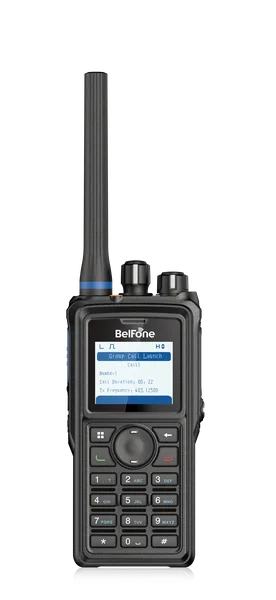
BelFone BP-660
BelFone lists 1,024 programmable channels, 64 zones, a 2,000 mAh standard battery, and published working-time figures under a 5/5/90 duty cycle. These figures describe memory capacity, programming and test conditions—not 1,024 licensed frequencies or identical battery life for every user.
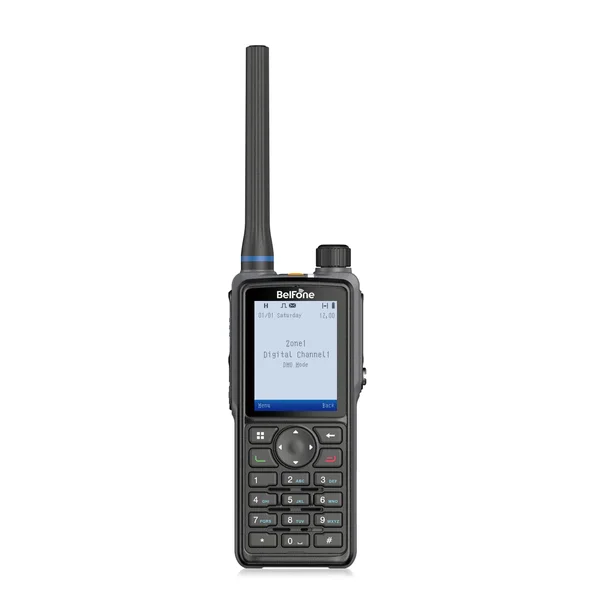
BelFone BP-860
Another professional digital-radio option. Confirm the band-specific version, programming, antenna and compatible accessories before comparing vendor quotations. Similar feature names do not establish universal interoperability.
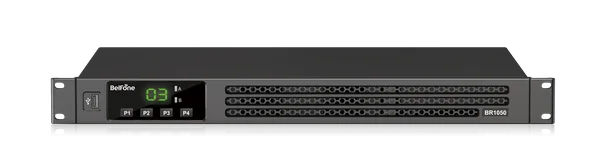
BelFone BR1050
A professional DMR repeater used here to illustrate why repeater input and output frequencies, duplexer characteristics, antennas, radio programming and regulatory permission matter. The unit's rated maximum output alone cannot guarantee any fixed coverage distance.
15. Three regulatory terms Saudi businesses should know
Frequency assignment concerns the permitted spectrum resource for the relevant radio service. Use authorization or license is the permission or compliance requirement applicable to the actual system. Equipment approval concerns whether the radio device meets the applicable equipment requirements; this is not interchangeable with permission to operate a particular frequency channel.
Professional radio operations in the Kingdom are governed by the Communications, Space & Technology Commission (CST). The official radio frequency license service and spectrum regulations provide relevant guidance. Do not assume a product advertised as “license-free” in another market is necessarily exempt in Saudi Arabia.
16. How to use the glossary in an RF quotation request
Rather than requesting “30 radios with a range of 10 kilometers,” describe the city, facility layout, number of users, work shifts, existing allocated frequencies, whether the organization already has analog or digital equipment, talk-group requirements, and locations where coverage is critical.
Ask suppliers to distinguish programmable channel storage from assigned RF frequencies, explain protection and battery-test conditions, verify repeater and handset compatibility, and itemize programming, licensing, installation, accessories, warranty and maintenance. Clear terminology leads to proposals that can be compared on engineering merit rather than attractive but unsupported claims.
Frequently asked questions
Do 1,024 radio channels mean 1,024 licensed frequencies?
No. They describe programmable memory capacity. Operating frequencies depend on the approved network design and applicable spectrum assignments.
Does a DMR color code encrypt calls?
No. A color code is a radio-network access parameter, not a security encryption method.
Will any two DMR radios always work together?
Not necessarily. Bands, channel settings, programming, talk-group identifiers and actual supported features must be compatible, and proprietary options may vary by model.
Is an IP68 radio automatically safe in an explosive atmosphere?
No. Ingress protection and hazardous-area approvals address different risks. The exact classified environment and required certification must be assessed.
Need help interpreting radio specifications?
Share your project location, user count and operational requirements. Wireless Signal can help identify suitable bands, handsets, repeaters, programming and accessories before preparing a tailored technical and commercial quotation.
Technical and regulatory references
- DMR Association — DMR standards and tiers.
- ETSI TS 102 361-1 V2.7.1 (2026) — DMR air interface.
- BelFone — Official BP-660 specifications.
- CST — Radio Frequency Licenses.
- CST — Regulations for Radio Spectrum Use.
An educational glossary, not a network design or license to transmit. Actual equipment variants, frequency authorizations and technical requirements must be verified for each site.